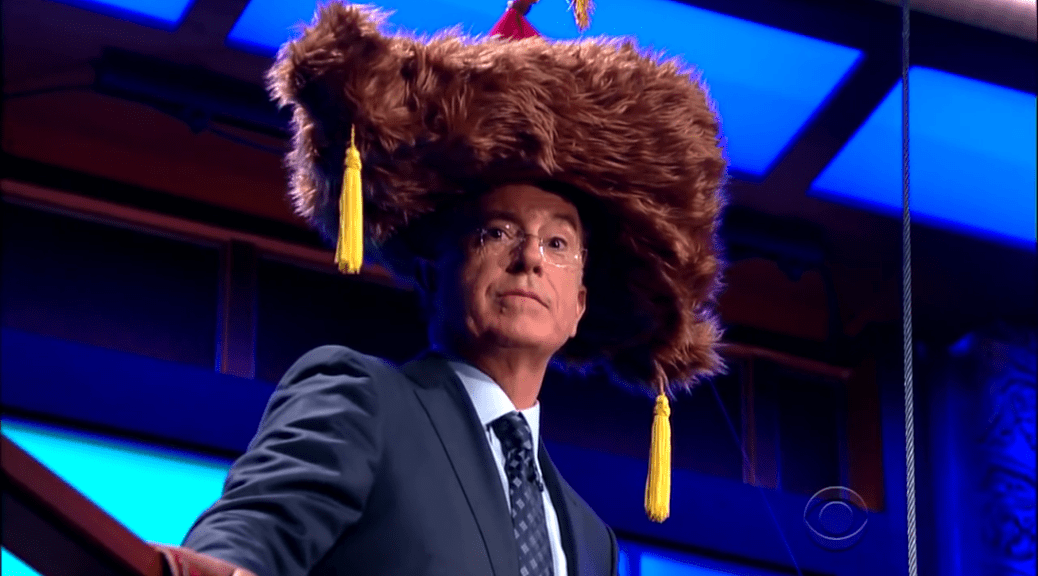
This is late night check-in, a feature where I watch a full week of one talk show and discuss how it was. Last week I watched “The Late Show with Stephen Colbert”, from 9/8 to 9/11.
On Thursday night, during an interview with Joe Biden, approximately four minutes and thirty-five seconds went by without the sound of laughter.
Colbert allows this silence to happen. He doesn’t try to force banter that would stifle the conversation. Instead, he listens, as do we. The Vice President talks about his son, Beau Biden, who has recently passed away from brain cancer. Biden mourns his son with a kind of honesty and vulnerability you might expect to hear if you were eavesdropping on a private conversation. It was incredibly difficult to watch, fraught with emotion from a wound that’s barely healed. It was one of the boldest things I’ve ever seen on a late night television program. Despite its brevity (some of it was cut for broadcast, although you can watch the full interview online), it packed an emotional punch and left an impression about what it means to keep moving forward in the face of incredible loss. I can’t recall the last time a talk show allowed this much room for not only a guest to be so candid about their state of mind, but for the viewer to reflect on something so heartbreaking.
The aforementioned was the clear highlight in a week full of them during the premiere week of “The Late Show with Stephen Colbert” and a terrific sign of things to come. In a packed late night world, Colbert has already started to carve out his own territory, as evidenced by the groundbreaking Biden interview. Before its premiere, the expectations for “The Late Show” have been absurdly high, with all the popular questions rattling throughout the blogosphere – what will the “real” Stephen Colbert do? Will the format be different? Without his blowhard persona to grasp onto, will Colbert sink or swim?
Turns out we all had nothing to fear. Colbert is sticking to the long time late-night formula that has worked since Johnny Carson dominated the universe – monologue, desk piece, interview one, interview two, musical guest/comedian. And while that might seem disappointing to those who were hoping Colbert would completely re-invent the wheel, it begs the question of how in God’s name you could possibly pull that off?
What keeps this old format from seeming ancient is the way Colbert twists each segment to match his style. Yes, there was a monologue, but it was brief and devoid of topical jokes (“Did you see this? Did you hear this?”) that every other late night show includes. Instead, each night featured a few light jokes, quick anecdotes, some banter. No scripted bits, save for one night that featured a parade of famous NFL players making cameos as “new employees” of the show. It was the closest the show came to being flashy for the sake of being flashy. Colbert throws to the band, they perform the theme song, announce the guests, and Colbert sits behind his coveted desk.
 The Post-Academy