Visual spectacle can’t overcome lack of substance in Hollywood’s last gasp of summer
Recently I spent a better part of September meandering about France with my girlfriend (humble-brag or just normal brag?). Pristine Alps, ancient ruins, feats of architecture – you name it, it was beheld. However, I’ve never been a big ‘sights’ guy. This is because, as someone who lives within an average work commute to one of the Seven Natural Wonders of the World, I believe you can and will become numb to any ‘sight’s’ beauty if exposed long enough. I know, cynical right? But just ask the people of Agra what they think of the Taj Mahal, or Chicagoans about the Cloud Gate (the bean thing). But what’s not cynical is the belief that absorption into a person, an idea, or a culture, is endless and endlessly more stimulating. Something, director Baltasar Kormákur would appear not to believe while making Everest.
Everest is a film about a mountain, but the story is about people – a lot of people. Based on Jon Krakauer’s best-selling account of the 1996 Mount Everest Disaster, Into Thin Air, Everest stars, well, a lot of stars. Jason Clarke appears to be the lead as he plays the New Zealand-bred Rob Hall, leader of Adventure Consultants, one of the groups tasked with escorting their climbing clients up to the top of the world. Josh Brolin, John Hawkes, and Michael Kelly – as journalist Krakauer – among others, take up roles as Adventure Consultant’s clients. Opposite Clarke is Jake Gyllenhaal as the resident shirtless and super-chilled-out-brah ski-bum, but also Scott Fischer, leader of the Mountain Madness adventure travel service. Emily Watson and Sam Worthington reside back at one of the many base camps relaying messages for a better part of the film, while Keira Knightley and Robin Wright play worried wife half-a-world-away for Clarke and Brolin respectively.
Grand Himalayan eye-candy is strewn about Everest, intercutting each new dramatization and pandering to 3D technology. It’s gorgeous and daunting, and helps to put in perspective the scale of such a venture. As our teams make their way from base camp to base camp acclimating to the altitude, we learn bits about where they’re from and why they’re here. What we don’t learn however is who they are. Characters are sketched haphazardly, defining them by their periphery relationships instead of delving into their psyche through dialogue and actions. Instead of zeroing in on a select few characters, the film casts a wide net, trying to give everyone their moments and their stories. As we ascend up the mountain, through the haze of snow blindness, goggles, and full-body snowsuits, keeping up with the large ensemble becomes confusing. The film’s flurrying attempt to include everyone casts a disorienting vibe over the second half of the film. This results in a lack of genuine emotional investment and participation from the audience. It’s also told from no particular perspective. Not using author and journalist Jon Krakauer’s point of view more, played by the instantly likable and relatable Michael Kelly, feels like a missed opportunity. The film slowly begins to feel like a mic’d up nature doc. 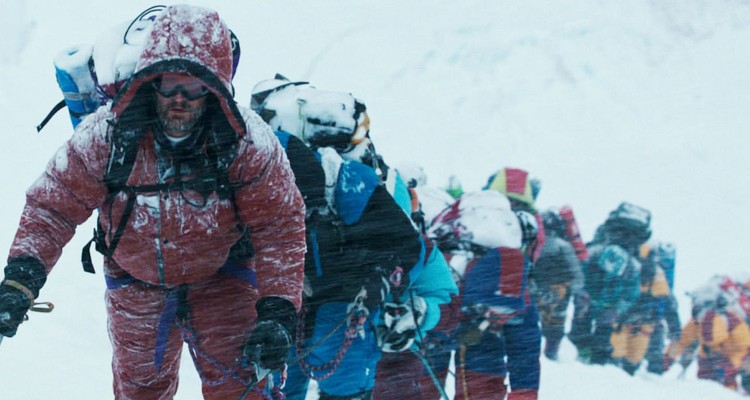
The suspense is littered throughout, often drawing you to the edge of your seat or putting an icy lump in your throat as one by one, each character must face the mercilessness of nature head-on. Its abundance of such moments may make it worth the price of popcorn for many; but to me, they’re empty surface emotions smothered by an avalanche of continuing peril. In the end, many people pass almost unceremoniously; Gyllenhaal’s one-dimensional Fischer seems to perish due to being too “chill brah.” Maybe people just succumb; maybe it’s often not dramatic at all in reality. But the onslaught of drama in the lead-up makes it an unbalanced and anticlimactic conclusion. With this cast, and this story, there’s no reason Everest shouldn’t be better than it is. Leaning on visuals, hollow gut-punches, and star-power, this film about great risk plays it safe.
Neil deGrasse Tyson, the Internet’s senior sci-fi film critic (unofficial) tweeted out this about Ridley Scott’s The Martian – “…where science, not human emotion, drives the plot’s Humor, Interpersonal Relations, Tension, & Suspense.” It’s interesting that Tyson perceives it this way, not that he’s wrong, but that science is a sufficient replacement for human emotion. Perhaps for him it is, because he knows science the way we know humans – he has a relationship with it. For me and the average audience these elements are hard to sense, the way an astronaut I’m sure can barely sense the thousands of MPH they are travelling aboard a spacecraft.
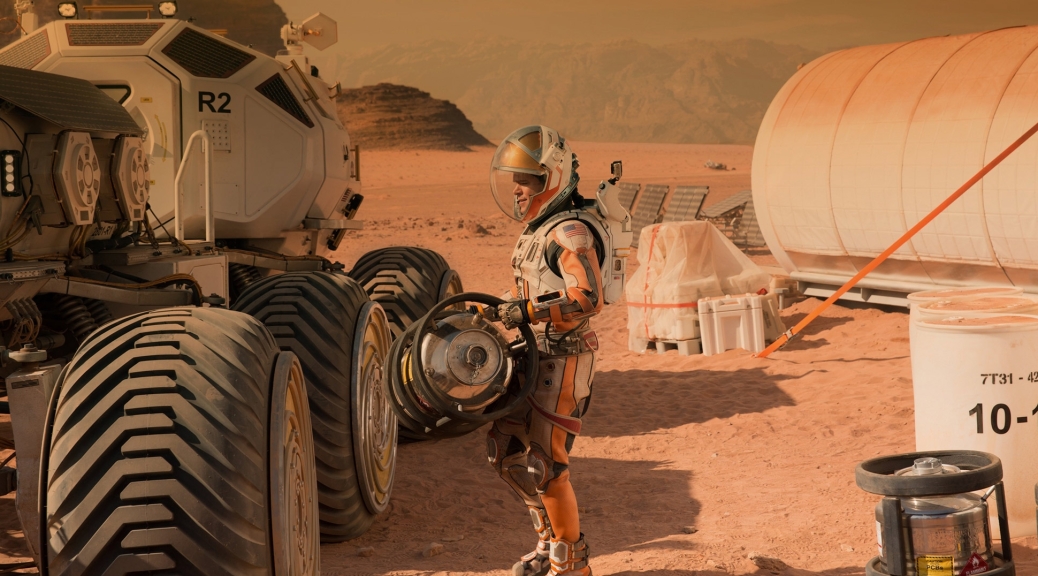
Matt Damon, as Mark Watney, plays a botanist left behind on a Mars mission after he’s presumed dead. This event takes place almost immediately, leaving the bulk of the film to Damon and his subsistence science. Chastain, Peña, and Mara among others make up the astronaut crew who left Watney and The Red Planet behind. Altogether, this crew is thinly sketched and a bit formulaic. Despite the large role they play in the film’s onset and outcome, they feel relatively irrelevant. Some of the best crafted characters and scenes are back in the proverbial NASA control room. Jeff Daniels is the hard-lining and pragmatic head of NASA, while Sean Bean, Ejiofor, and Wiig make up the more empathetic decision-makers on the blue dot. The back and forth between these characters, conferencing over Watney’s fate, is suitably smart and engaging.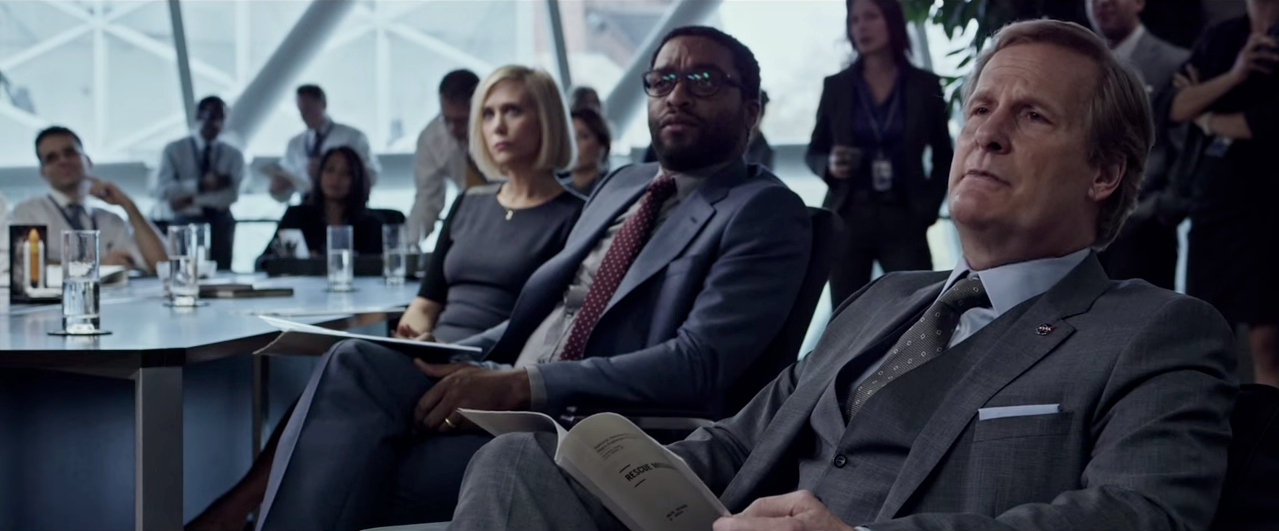
First off, Mars looks gorgeous on the big screen in all its alien inhospitality. It’s thrilling to finally see this place constructed in such rich detail. However, Scott is happy with the barren red landscape simply playing the backdrop for Damon’s coy wit. It could’ve been a compelling main character; a deeper exploration into this setting would’ve been a welcomed treat. Furthermore, for a film about being abandoned in space, there’s very little peril involved. It’s more about calculation and levity here as science projects and gallows humor thread the film from end to end. Damon and the script craft Watney as the confidently snarky survivalist, but fail to let him truly emote. You’d think spending over a year alone and millions of miles away from everything you’ve ever known would elicit some pensive moments of isolation, a mental breakdown, or maybe some philosophizing about one’s place in the universe. Instead we get clichéd complaints about disco music and these kind of self-centered, very American logical stretches like “So, technically, I colonized Mars. In your face, Neil Armstrong!” (Another, where he concludes he’s a space pirate based on Maritime Law.) Then, the second I heard “I’m gonna have to science the shit out of this!” my eyes rolled all the way back into my head. All I could see were those ‘I FUCKING Love Science’ Facebook groups that consist of memes about Pluto not being a planet and videos of like, chemicals doing weird shit when mixed with other chemicals. Compare that with Interstellar’s “Love is the one thing we’re capable of perceiving that transcends time and space” and Ridley Scott is out here making Christopher Nolan sound like Voltaire.
Don’t get me wrong science fiction can be fun, but it’s also responsible for some of the most poignant musings on class, humanity, technology – you name it; and for a stage like this to play it so safe thematically is disappointing. The first Mars movie in the age of CGI and actually plausible possibilities of life on Mars is a bit underwhelming intellectually. It’s an enjoyable ride no doubt, but it’s a simple one. Damon is clever and incredibly watchable as always, but there are few surprises or bumps along the way as the film coasts towards its very-foreseeable conclusion.
 The Post-Academy