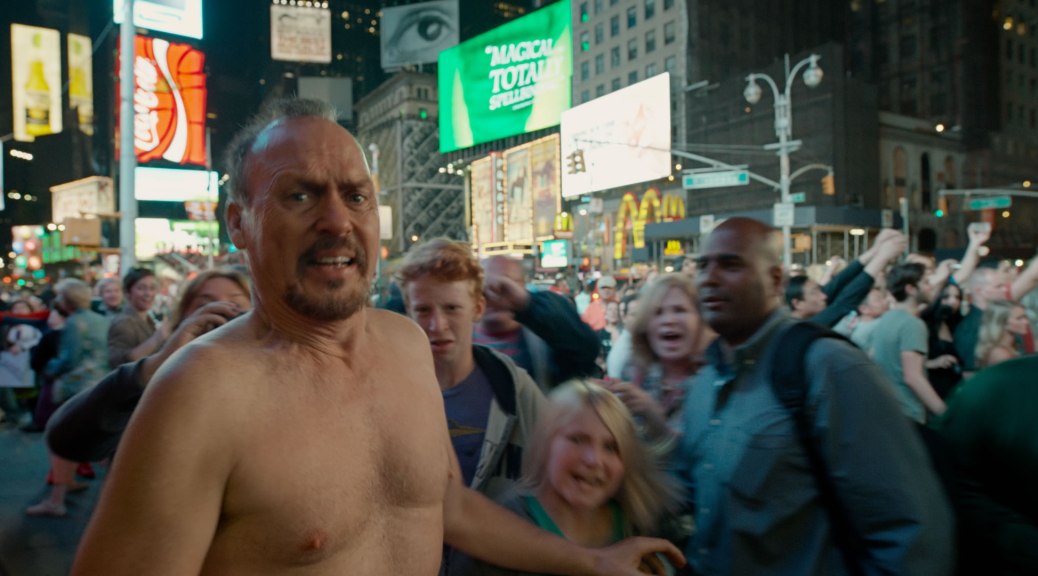
1. Birdman or (The Unexpected Virtue of Ignorance)
Birdman opens with a levitating cross-legged Riggan Thompson (Michael Keaton) being heckled by the Luciferian voice of his former role as Birdman. Throughout the film, Birdman revisits Riggan, stroking his ego and egging him on to return to his superhero form. “You tower over these theater douchebags. You’re a movie star… You are a god.” All the while Riggan is determined to validate himself as an actor—as an artist—with his Broadway production, an adaptation of Raymond Carver’s What We Talk About When We Talk About Love. Riggan is not only the star of the production but also the director and the writer.
When a stage light falls on the key supporting actor’s head, Riggan is forced to re-cast. He rattles off a list of Hollywood stars to his agent Jake (Zach Galifianakis); Jeremy Renner? He’s an Avenger. Fassbender? Doing X-Men. Each proposed substitute is involved in the same buttered-popcorn-franchise-blockbusters that cast a shadow on Riggan’s life. That’s when revered thespian Mike Shiner, played ferociously by Edward Norton, appears. If Birdman is the preacher of fame and worship, Shiner is the pope of artistic integrity. Shiner is a method actor who drinks real gin during a dinner scene, and attempts to have actual sex with Lesley (Naomi Watts) during a bedroom scene, all in front of a live audience. Emblematically, without an audience Shiner is impotent. All the world’s a stage, right?
The war between reality and fantasy has been waged. Alone, Riggan performs feats of levitation and telekinesis. Sending lamps and shelves crashing with a flick of his wrist, soaring through the New York cityscape, and even blowing up a car as he walks by. Birdman is a surrealist painting begging you to believe it’s real. And you may give in. Director Alejandro González Iñárritu leaves conflicting clues whether Riggan really possesses superpowers and what is really real. Conspicuous shots of fiery objects streaking through the atmosphere, the film’s score physically manifesting itself, and powers becoming moot once a peer enters the room. It’s a profoundly funny bending of meta-reality, but it’s also subtle when it needs to be. The concept is kept at bay, playing a supporting role to Riggan’s struggle with redemption and relevancy in both the art and the family he fell in love with. He struggles to mend familial relationships between his ex-wife Sylvia (Amy Ryan) and his fresh-out-of-rehab daughter Sam (who is also his assistant, played fearlessly by Emma Stone) that his former Hollywood ego left bruised and neglected. With Birdman Iñárritu manages to grasp at tangible themes like self-acceptance and relevancy and turn them into a lucid, trippy tour-de-force. This is hard to imagine coming from a director known for exhausting non-linear opacity and bleak meditations. Not to mention, it’s so god damn funny! Where has this guy been?! At one point alter ego Birdman taunts, “People, they love blood. They love action. Not this talky, depressing, philosophical bullshit.” You get it.
This is not without the help of virtuoso cinematographer, Emmanuel Lubezki (Gravity, Children of Men) who all but steals the whole dang show. As you’ve probably heard by now, nearly the entirety of the film gives off the appearance of being shot continuously in one long take. Of course it’s not, but man, is it a wonder to observe. It’s a feat of technical craftsmanship that will become something of a genesis for future cinematographers. Outside of Gaspar Noé’s first-person DMT ride, Enter the Void, this is arguably the most voyeuristic film experience in recent times. However, it’s different from other trips down voyeur lane in that you are put in the observing mind of the director and his camera, rather than that of a character’s. This sounds like it might feel a bit cold and art-student-y, but it works because our protagonist Riggan is directing as well. He’s directing himself in a play, and we’re directing him direct himself. Soon, we begin to feel like we’re navigating through scenes the way a director might navigate through them in his mind. In short, we’re on board.
So on board that I’ve chosen to believe that Riggan Thompson does in fact possess super-human qualities. I want that, and Iñárritu wants us to have fun this time, and I’ll gladly oblige. He can’t help himself though, so Riggan suffers, but he doesn’t wallow. That makes all the difference. He faces adversity and then he soars. It seems simple. It is simple. But perhaps, it took Iñárritu taking that tried-and-true arc away for us to realize how sublime it can be.
2. Boyhood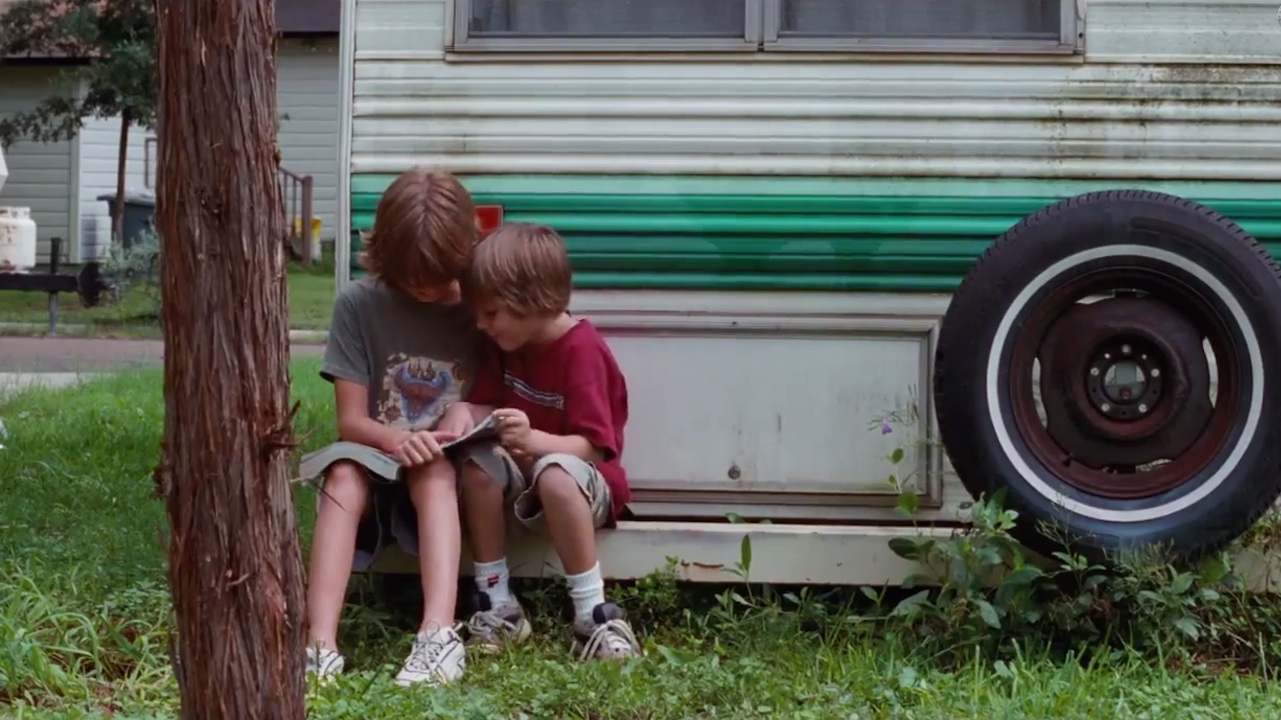 If you are familiar with Richard Linklater’s work you know he has a unique obsession with time as a sort of indie special effect. And for the past 12 years he’s secretively worked on one of the most audacious film projects of all time. By utilizing the same actors, and filming just once a year, we don’t have to imagine much about these lives lived. It really is hard to underestimate the trippy sentimentality of watching people age 12 years in just a matter of hours.
Linklater has always preferred to convey a feeling rather than a story, and with Boyhood it’s a smorgasbord. The film is sprinkled with callbacks of pop culture and politics from over the past decade that only enhance the nostalgic hue. But it’s the honesty and the range of the characters that weave their way through young Mason Jr.’s (Ellar Coltrane) life. From alcoholic step-dad to high school girlfriend; there’s an ethereal sense of familiarity to it all. Linklater’s always been skilled with realism, but this is the largest canvas he’s (or anyone’s) had to paint on. Instead of dramatic plot arcs, the film works at catching the little minutia of everyday. Things like showing Dad (Ethan Hawke) his rock collection, or getting late night Mexican food in an unfamiliar city. Things that make you go ‘ahh, I remember.”
Like most childhoods, the film is carried upon the weighty shoulders of Mom, played by Patricia Arquette. Hawke plays the down-to-earth, street-wise, used-to-be-in-a-band half of the single parent spectrum, and he plays it warmly and with wisdom. But Arquette, as Olivia, is the rock of Mason and his sister Samantha’s (Lorelei Linklater) everyday life. From the simplicity of dropping kids off at school to going back to school herself; her portrayal of the ebbs and flows of being a young single mom, still finding her way through her very own life, is touching. But Coltrane’s the star, and while the adolescent performances can seem underwhelming at times, their awkwardness aides the film’s inherent pilgrimage of authenticity.
3. Force Majeure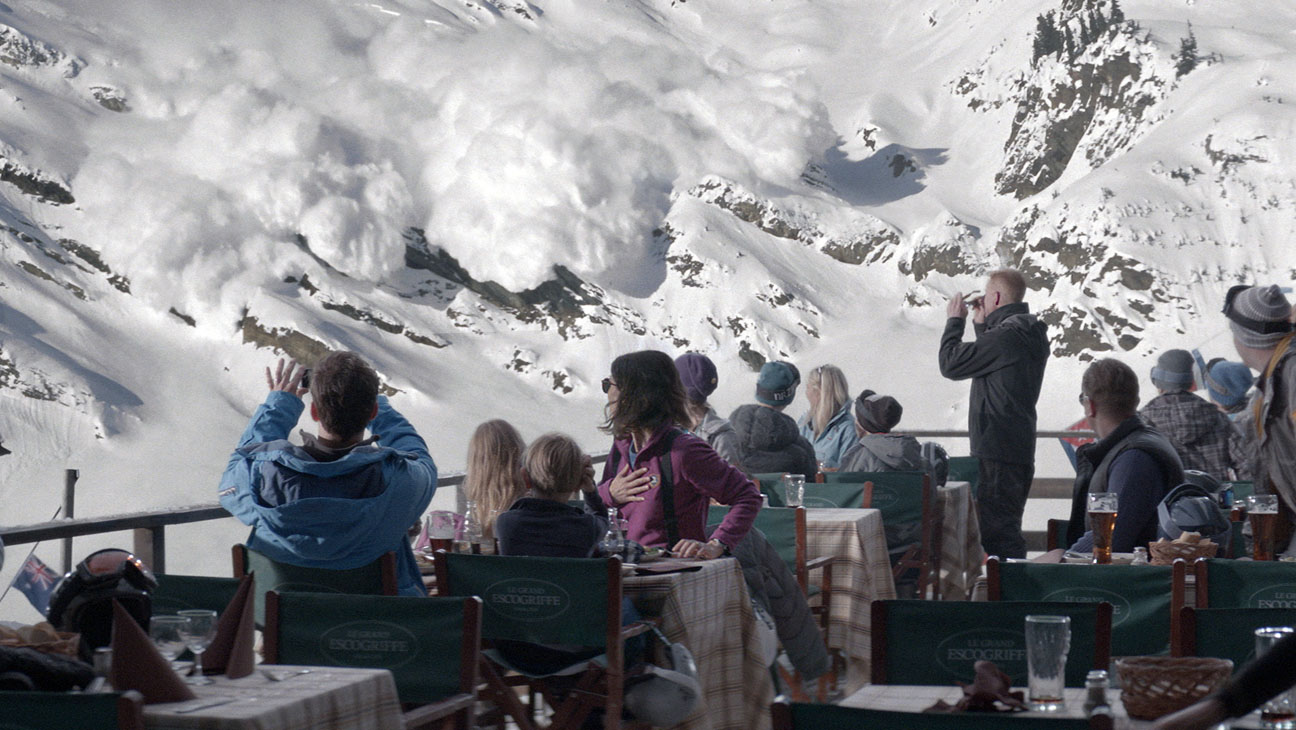 Not unlike a cascading wall of alpine snow, it’s hard to see this one coming. Swedish director Ruben Ostlund’s tightly wound familial drama worms its way into the id and ego, tugging at pillars of masculinity and responsibility. A simple family ski vacation to the French Alps becomes a nail-biting exploration of gender psychology when a father, Tomas (Johannes Bah Kuhnke), instinctually abandons his family during an, albeit harmless and controlled, avalanche.
Tomas and his wife Ebba (Lisa Loven Kongsli) begin a marital cold war when Tomas denies his fault. Ebba, hurt by his dishonesty and lack of character, resorts to using other couples as a jury in their dispute. Naturally, the subject ripples and infects the other couples’ symbiosis. This result is titillating uncomfortableness. When the sun goes down a sudden and taut orchestral score arises, an eavesdropping janitor emerges, and striking imagery of the resort is displayed. It’s not a coincidence that this is also when the quarrels occur. All this gives the place an eerie sentience, as if meant as a catalyst in some therapy experiment – almost à la Overlook Hotel.
It’s a relationship thriller that kept me slack-jawed by its tension and complexity of its characters. Avalanches aren’t a bad choice as analogies for mid-life mental breakdowns either. And the terrifying helplessness the children (Clara Wettergren & Vincent Wettergren) convey, as they fear the worst for their parent’s marriage, is truly heart breaking. Long dialogue-driven scenes, fantastic emotive performances, and gorgeous cinematography make Force Majeure perhaps the most enveloping film of the year.
4. Snowpiercer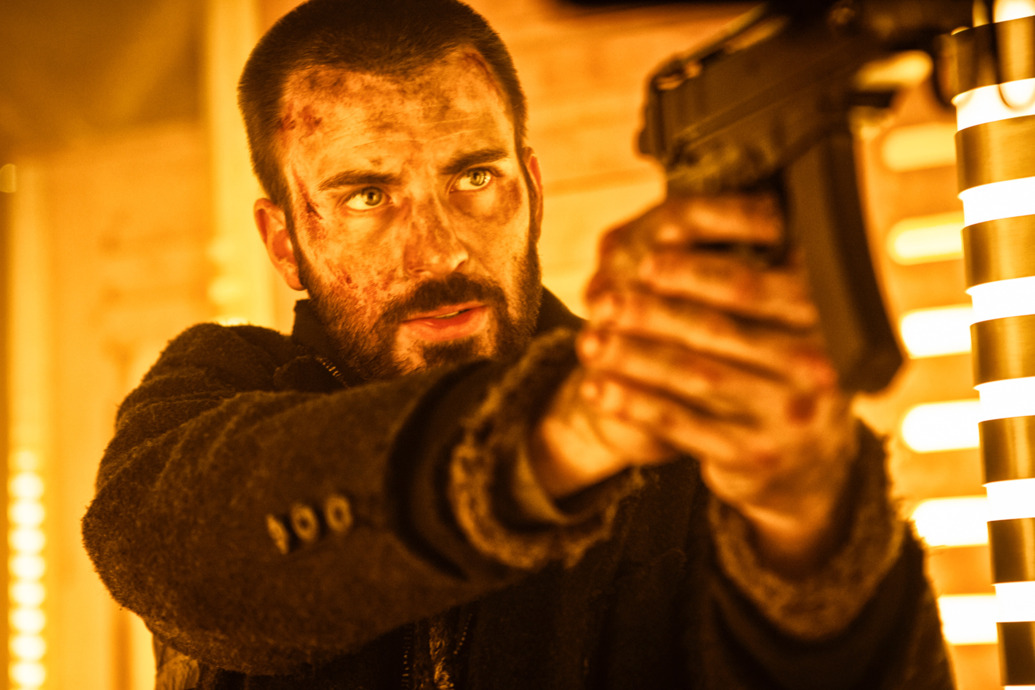 I have to say, this was the most fun I’ve had watching a movie in a long time. Snowpiercer is set in a frozen post-apocalyptic Earth (not hard to imagine currently), due to an attempt to stop global warming gone awry, where all of humanity lives aboard a high-speed self-sufficient train. When the lower-class inhabitants in the back of the train revolt and head for the front, a grimy, bloody crusade, led by Chris Evans’ fierce performance of Curtis Everett, begins.
While this sounds a little heavy, South Korean director Bong Joon-ho coats the film in a self-aware layer of dark humor to lighten the mood. Caricature authoritarian figures (Tilda Swinton is brilliant), machine gun wielding elementary school teachers, and drug-huffing security specialists are all invited. Joon-ho’s action is stunning visually. Each new train-car acts as the next engrossing level in this sort of hyperreal, cinematic, 2D video game. Torch-lit passageways, fur-coat nightclubs, and steamy saunas are just some of the many contrasting settings sure to satisfy every aesthetic palette.
Obvious metaphors for modern revolution and classism here of course, but there’s also a curious biblical sub-motif at play. The train is conducted by the never-before-seen, engineering virtuoso, creator of said train/ecosystem, known only as Wilford (Ed Harris); H to the Izzo babaayy! In biblical stories, humanity is often portrayed as chaos that needs to be dealt with ruthlessly, for it’s own good. There are shades of that in Snowpiercer, and it forces you to ponder how steadfast your humanity would be when granted such God-like control. OR, maybe it’s a clever satire on Amtrak service? Either way, don’t think too hard about this one, or you might forget to hold on.
5. Under the Skin Anatomically close-up eyeball engineering, streaming tunnels of blood, and lethally hypnotic monochrome seduction – what a perfect movie to walk out of and into a dark, empty parking lot. Much of Under the Skin rings of that creepy Kubrickian ambiguity found in sci-fi horrors 2001: A Space Odyssey and The Shining. Fear of the unknown is the greatest fear in cinema, and British director Jonathan Glazer means to keep us in the same murky darkness as his film’s hapless victims.
Scarlett Johansson delivers a subtle and superbly unique performance as a bewildered alien planted in a human body. Her mission is to lure strolling Scottish men into her abode, but unbeknownst to the lucky horn-dogs, it’s for reasons that might keep even you or I from going home with Ms. – sorry, MRS. Johansson. Through her eyes we see a foreigner observing humanity, discovering humaneness, and exploring femininity all for the first time.
6. Whiplash By the end of Whiplash, you can’t help but feel like you caught a glimpse of a virtuoso in the making. Sure sure, Miles Teller as Andrew Neiman the wunderkind drummer, but IRL, first time director Damien Chazelle gets the standing O. Hair-raising ferocity and anxious determination guide you through the movements, up and down, ever so gradually, until one of the greatest movie crescendos I have ever seen. If you only catch the final scene, you may understand the whole film; but it’s so much more worth it once you let J.K. Simmons (as sadistic conductor Terrence Fletcher) draw blood a few times.
7. Selma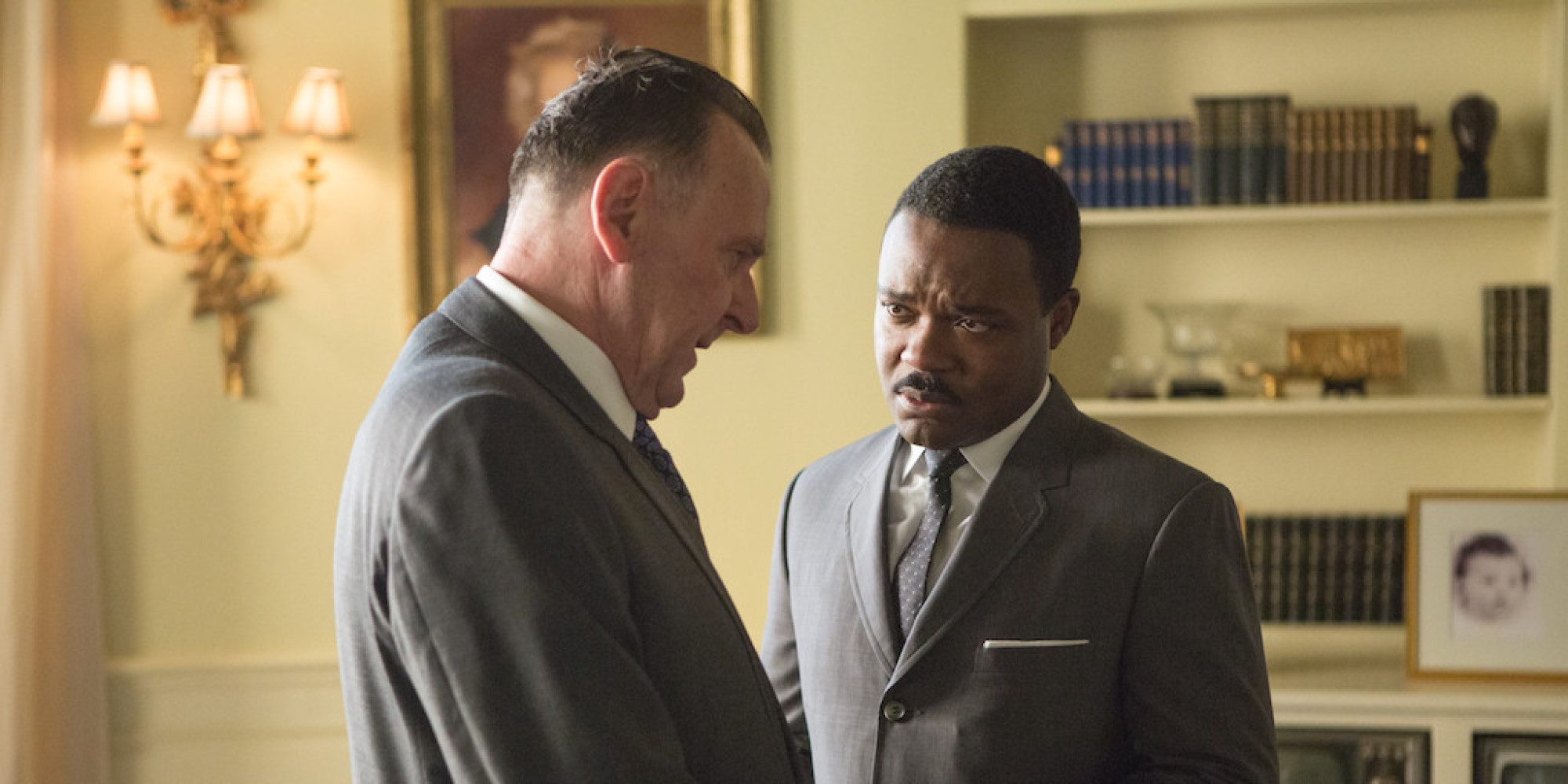 None of Martin Luther King Jr.’s actual words could be used in Selma due to having been licensed to DreamWorks and Warner Bros. for an eventual Spielberg produced MLK biopic. So with that being said, director and writer Ava DuVernay should be immediately commended for the film’s powerful prose. And with Selma that power comes with great grace and nuance. Seamlessly interwoven subplots glide together, just like the people of Selma, Alabama, as one cohesive narrative movement, bound by the words and presence of David Oyelowo’s brave performance. Not just his stirring speeches, but also the lighter moments, the laughter, and the resoluteness of a man who “…stands up and says enough is enough.”
8. Guardians of the Galaxy For those of us suffering from superhero-desensitization to the point that you still can’t even muster the courage to see the Avengers movie (yeah, that’s me), fear not! Chris Pratt is here! The lovable doofus from Parks and Rec who now holds the reigns to three (four if he reprises LEGO role; crazy) of the biggest film franchises in America somehow; what the hell, how did this happen? I don’t care how it happened. All I know is I want more of whatever Guardians of the Galaxy is. Is it a biting satire? A total farce? Who cares, Vin Diesel plays a tree! There’s disco music, I N S P A C E. Chris Pratt calls himself Starlord, what is he on a Trekkie message board? I love it. See this.
9. Citizenfour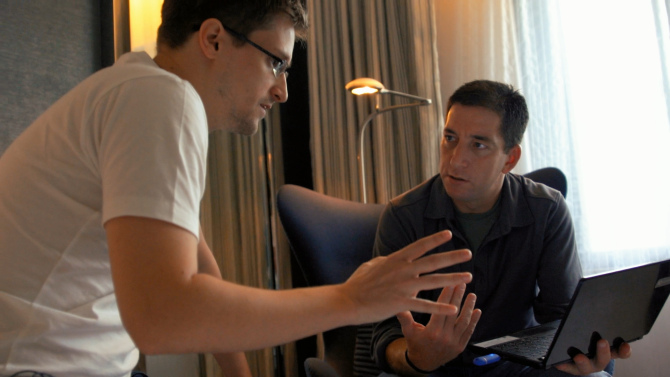 The conception of most historical documentaries is usually sometime after the film’s event or subject has passed, or more so, after there’s been some time to digest such an event or subject. But with Citizenfour, the camera starts rolling without knowing where it’s going to end up. Before Edward Snowden became a household name, he secretly contacted acclaimed documentary filmmaker Laura Poitras to help chronicle his story. We follow Poitras, Snowden, and investigative journalist Glenn Greenwald around the world as they work together to strategically facilitate the release of the now infamous NSA leak. It’s a remarkably gripping, post-modern, cyber-thriller that’s slow-cooked and grounded in unwavering matter-of-factness. It may not change your mind either way about Snowden, but it’ll at least give your stance some journalistic integrity along with a more intimate look at one of the most mysterious men in American history.
10. Leviathan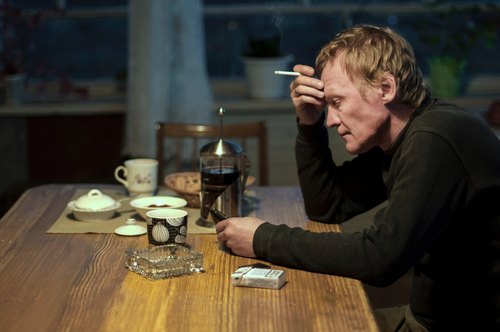 Here we have one of the few credible David and Goliath tales. Credible because Goliath squashes David – sorry kids, it’s a cruel world. And even crueler if you’re living in rural Russia it would seem. Russian director Andrey Zvyagintsev gives Kolya (Aleksei Serebryakov) only a puncher’s chance when a corrupt mayor wants to repossess his property by means of shady legal expedients. Kolya’s wife and son, his close friend turned lawyer, and his small community all play a role in this epic, old-school tragedy of power and betrayal. Crashing black waves, beached whale skeletons, and a chilly, barren landscape accentuate the lonesome tone of utter and complete hopelessness against odds too great.
The Next Five Up: Foxcatcher, Calvary, Interstellar, Still Alice, Only Lovers Left Alive
Favorite Under-seen Indies: Dear White People, The One I Love, The Skeleton Twins, Joe, Obvious Child
The Most Overrated: Frank, St. Vincent, Nightcrawler, The Grand Budapest Hotel, Theory of Everything
 The Post-Academy