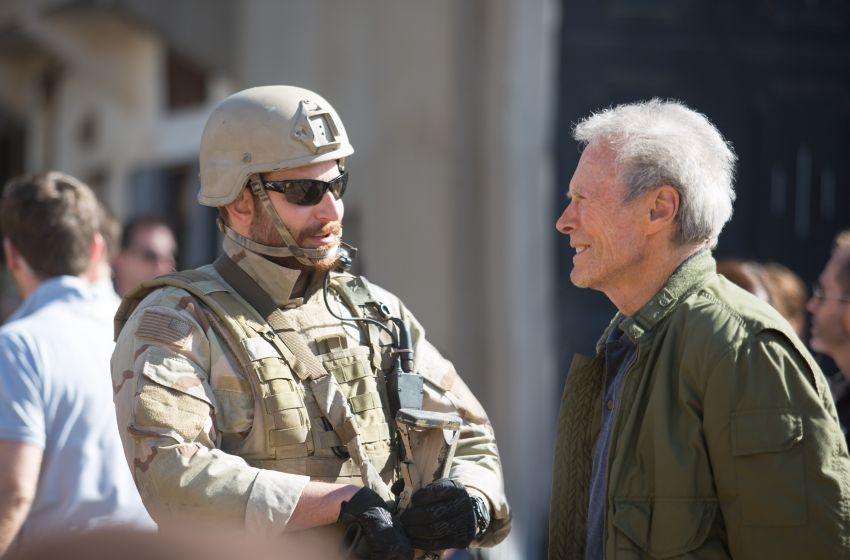
Sniper leaves a parable of reactionism in its wake
For the past few weeks, no matter what part of the country you’re from, America has been under attack. We’ve endured a blitzkrieg of mortar-launched articles, think-pieces, tweets, op-eds, Facebook posts, TV rants, reactions, and even challenges, leaving a hazy fog of opinions to settle on the nation. On one side we have the ever-present “war is some badass shit” party. Opposite them resides the up-and-coming “war is like, not chill” party. For every bold countryman who took a shot at American Sniper and its drawling hero, an equally courageous samaritan recoiled and fired back in the reactionary way that one does when a stranger says something about your mother. It was clear there was no common ground to be seen, well, except for the film itself. Have you guys seen the film?
[Gasping for air as I snap out of pun-induced blackout] Ok. Give Clint Eastwood credit for creating a patriotic Iraq War movie that isn’t necessarily pro-war, but not too much credit. Eastwood shies away from making it a wholly anti-war film, and what could have been a damning portrayal of post-9/11 American foreign policy. Instead he articulates Chris Kyle’s red, white, and blue ‘true’ story in shades of grey.
First of all, taking political statements from troops should never be your first choice. I understand there’s a utility to having a first-hand account, but their heads are largely slathered with propaganda. They also are taught a strict adherence to whatever an unseen disciplinary chain of command tells them. These men are not geopolitical analysts; they are soldiers. But that’s neither here nor there; because forming political opinions based on this film is very odd anyway considering it seems deliberately apolitical. There isn’t one mention of the phrase ‘Iraq war’, ‘weapons of mass destruction’, or ‘Saddam Hussein’ and I believe I only heard ‘terrorist’ once. There isn’t a shot of a TV with pundits debating the legitimacy of said war either. Yet, we do see Kyle watching the news as it reports of the 1998 U.S. Embassy bombings in eastern Africa. After seeing this, Kyle enlists in the U.S. Navy looking to “be of service.” The next time we see a TV it’s September 11th, and Kyle and his newly married wife are visibly distraught. Kyle is sent to Iraq immediately after. That’s where it gets tricky.
It’s easy to say that Eastwood is being irresponsible by implying that the invasion of Iraq had anything to do with 9/11. But the truth of the matter is that, for better or worse, this tale is 100% from Chris Kyle’s perspective. Kyle enlisted without an attack on American soil even occurring, so it’s easy to assume he couldn’t have cared less if Saddam Hussein was hiding WMD’s under his totalitarian ‘stache. It was America time. War o’clock. Gun hour? Whatever. It’s a film adaptation of an autobiography, and Eastwood takes that very literally. ‘Don’t shoot the messenger’, Clint says (for the first time in his life). All complaints regarding humanitarian faux pas are to be forwarded to the residence of Mr. Christopher Kyle, punk.
It’s a peculiar political retreat for a guy who, when he didn’t have the desired debate opponent present at the 2012 Republican National Convention, opted to scold a chair. But what’s forgotten about that speech is he criticized President Obama for continuing the war in Afghanistan, and somehow got a raucous applause from the red-blooded crowd. And on the President’s goal of bringing home the troops, Eastwood quipped “why don’t you just bring ‘em home tomorrow morning.”
The fact of the matter is Clint Eastwood is decidedly anti-war; a borderline pacifist, but he prefers to call himself a libertarian. In a 2011 interview with GQ Eastwood stated that he started out as an Eisenhower Republican, “because he promised to get us out of the Korean War.” And he slighted the current GOP mindset, stating, “And over the years, I realized there was a Republican philosophy that I liked. And then they lost it. And libertarians had more of it.”
If Eastwood chose a statement to make, he chose the safest possible one (or so he thought), PTSD and the plight of the returning veteran. I imagine he hoped that this would properly express both patriotism and anti-war sentiment. But when he could’ve hammered it home, he only nudges. Chris Kyle’s ‘recovery’ happens all too quickly, when it could’ve elaborated on his dangerous need to maintain his legacy. There are moments that emphasize the psychological effects; Kyle’s brother, a young kid wearing the distressed face of someone who has been made to do and see horrible things, mutters “fuck this place” to Chris, then jogs off towards the aircraft sending him on his next tour. But ultimately, too much time is spent hot-doggin’ it on the battlefield for any snippets of PTSD to really stick.
American Sniper is good film. The craftsmanship, Bradley Cooper’s performance, the pacing – all top notch. But what keeps it from being great is it doesn’t take any chances. And at the end of the day American Sniper doesn’t say much other than ‘this is what happened.’ The only lie of the film is Chris Kyle’s humble aww-shucks attitude. Excerpts from his book show a cocky, war-mongering, hateful side. He refers to killing as a “fun” thing he “loved” and bragged about looting Iraqi family’s apartments. Not to mention the unverified post-war tall-tales of murdering two car-jackers at a gas station, knocking out Jesse Ventura, and picking off looters during Hurricane Katrina.
To the films credit (I can’t believe I’m saying this), it does use Kyle’s preferred term of “savages” to describe Iraqi civilians and militants alike. But for the most part his feelings about Iraqi’s are portrayed in a vague ‘just doin’ my job’ type of hue. Especially in this war, it is problematic to express anti-war feelings in the context of American lives and not also Iraqi lives. As we did with Vietnam films, we express discontent with the war but not empathy with non-American victims or remorse for our actions. There’s a black and white good-bad dichotomy to American Sniper that unfortunately probably mirrors Kyle’s thought process. The film didn’t have to humanize Iraqi civilians because Chris Kyle didn’t, but it could’ve, and it would’ve been a better movie for it.
During an Oscar’s season that also produced the mesmerizing biopic of Martin Luther King Jr., Selma, American Sniper’s left-right so-called ‘controversy’ has engulfed the media. When we could be talking about Selma’s timeliness, in a year that has uncovered deeply disturbing white supremacist sentiment in parts of America, we’re re-hashing Iraq War bullet points. Meanwhile, so-called “Patriots” rushed to the box office to see their white rodeo hero fuck up brown peoples lives from a considerable distance. Effectively sending the message: the paranoid occupation of 3rd world countries is more ‘American’ than the pursuit of freedom and equality in a democracy when that pursuit is black. Black freedom is not seen as as patriotic as white domination, in essence. Both films are about people believing they’re protecting American’s freedom: one had an unquantifiable positive impact on millions, and one had his kills tallied in a conflict that spawned ISIS. And even though Selma switched from limited release to full-blown wide release a week before Eastwood’s film, it still has made less than a fifth of American Sniper’s earnings at the domestic box office.
It’s hard for a lot of Americans to not fully support anything associated with our wars, especially if they’re relatively recent, because that’s somehow “un-American.” That’s a big problem. It’s also easy to see troubling pro-war statements in every scene in every war film if you want to see them. That’s a little problem. The film truly wishes to make no enemies nor incite fanaticism, but it’s a futile mission. There will always be a section of the audience that sees war films as advertisements for recruitment centers preying on young minds, and a section that thinks that’s just okay. The biggest problem with American Sniper is the reaction to it. Many scenes and lines are so matter-of-fact neutral that they could be interpreted as both anti-war bias or hoo-rah jingoism depending on your frame of mind. And maybe that’s the genius of it, maybe that was Dirty Harry’s ambiguous plan all along. The fact is American Sniper may have reached a middle ground, but nobody’s willing to leave their trenches to meet it.
 The Post-Academy